
11-16 Education
At this intermediate stage of general education, the 11-16 curriculum should:
- be academically broad and challenging
- promote spiritual, moral, cultural, mental and physical development
- prepare older children for the opportunities, responsibilities and experiences of subsequent years
- promote health, safety, enjoyment and achievement
Beecham tutors can help ensure none of the desired goals of 11-16 education are compromised.
Beecham Tutors can provide off-the-peg or bespoke 11-16 support:
- On a subject basis (see the subjects offered below)
- On a subject-cluster basis
- On a curriculum-wide basis
Most of our 11-16 tutors are able to teach a number of subjects in the same cluster. For example, a Geography tutor will be able to teach Environmental Management and a Business Studies tutor will be able to teach Economics.
Beecham Tutors does not support certain subject areas – as shown below. However, we can supply or introduce parents to specialist teachers with regard to the development of artistic, creative and musical abilities.
The subjects we teach are designed an delivered with enhanced or accelerated learning in mind, aimed to produce highly-able and confident learners at the 11-16 stage. The content of our age-specific subjects are more challenging than those taught at schools.
11-14 SUBJECTS
Characteristics of 11-13 educational models:
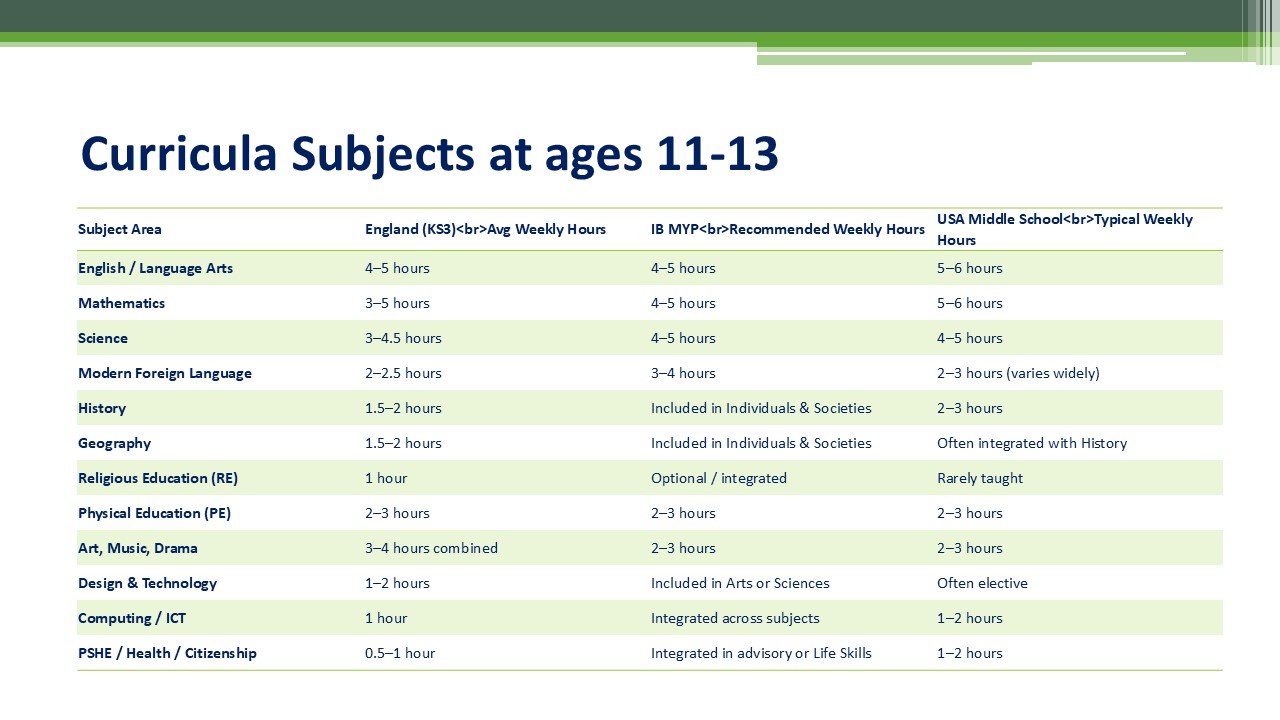
Here is a comparative table showing prescribed subjects and weekly classroom hours for students aged 11–13 (KS3 in England), alongside the International Baccalaureate Middle Years Programme (IB MYP) and typical U.S. middle school curriculum. Note that this is a generalised guide and hours can vary by school and region:
Annual Classroom Time Estimates ages 11-13
Assuming a 39-week school year:
- KS3 England: ~30 hours/week → ~1,170 hours/year
- IB MYP: ~30–35 hours/week → ~1,200–1,365 hours/year
- USA Middle School: ~30–32 hours/week → ~1,170–1,250 hours/year
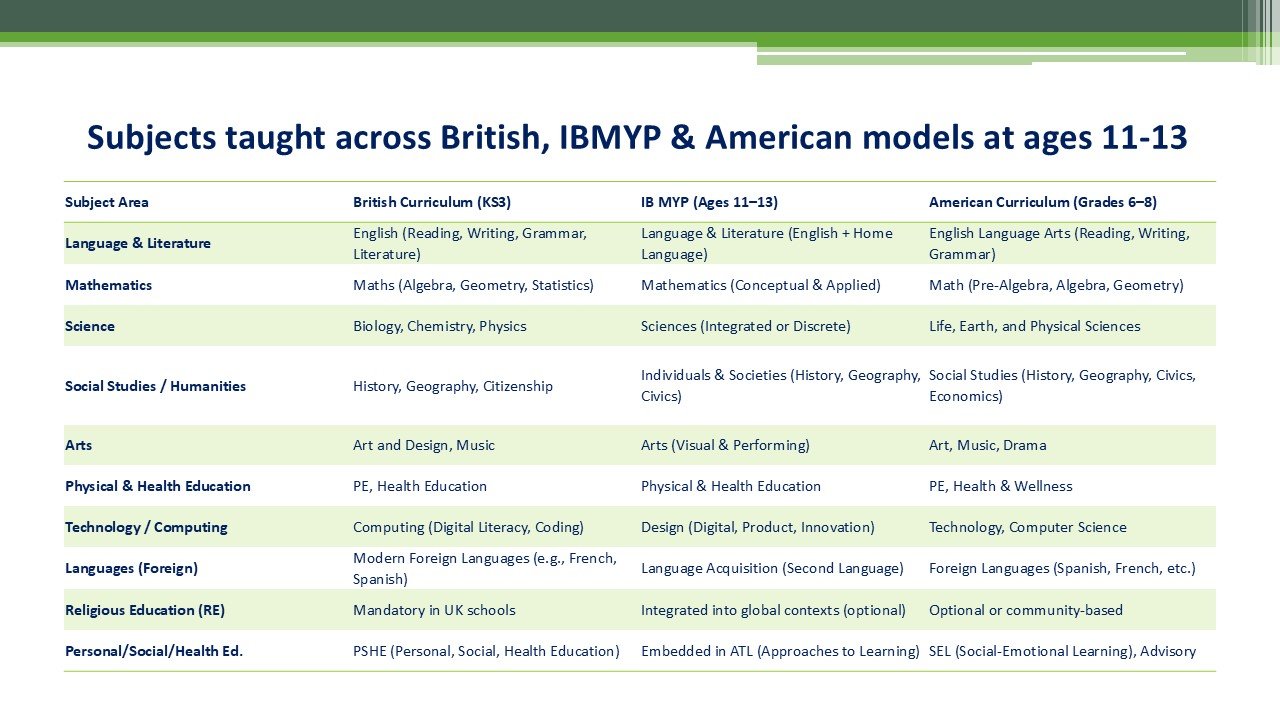
Subjects commonly taught across the three 11-13 models:
Ages 11–13 mark a pivotal stage in education, where students transition from foundational learning to more specialized subjects. Here’s a comprehensive comparison of the subjects taught across the British Curriculum (Key Stage 3), the IB Middle Years Programme (MYP), and the American Curriculum (Middle School Grades 6–8).
Key Philosophical Differences
- British Curriculum: Structured and subject-based with national standards and assessments. Emphasis on academic rigor and preparation for GCSEs.
- IB MYP: Inquiry-driven and concept-based. Subjects are taught through global contexts and interdisciplinary units, with a strong focus on personal development and international mindedness.
- American Curriculum: Varies by state but generally follows Common Core or state standards. Offers flexibility and elective options, with increasing emphasis on critical thinking and standardized testing.
SUBJECTS
11-13 support offered by Beecham Tutors:
11-13 subject areas of support which can be aligned to all three educational models:
GROUP I (Native Language) – English (Reading, Writing, Grammar & Literature)
GROUP II (Classical Languages) – Latin
GROUP III (Mathematics) – Mathematics (includes Algebra, Geometry & Statistics)
GROUP IV (Sciences) – Biology – Physics – Chemistry
GROUP V (Computing) – Computing (includes Coding) – Design (IB) – Technology (US) – Computer Science (US)
GROUP VI (Humanities) – History
GROUP VII (Social Sciences) – Geography
GROUP VIII (Foreign Languages) – English as a Foreign Language (EFL) – French – German – Spanish – Chinese – Japanese – Arabic – Portuguese
GROUP IX (Interdisciplinary) – At the 11-13 stage, there are limited formal interdisciplinary mandates and are integrated in subject-based teaching.
GROUP X (Arts) – Music
GROUP XI (Specific Musical Instruments)
- Beecham Tutors does not support the subjects of Art & Design, Drama & Theatre, Dance, Film Studies, Media Studies, Citizenship, Religious Studies, Physical Education and Personal/Social//Health Education.
14-16 SUBJECTS
Characteristics of the three 14-16 educational models:
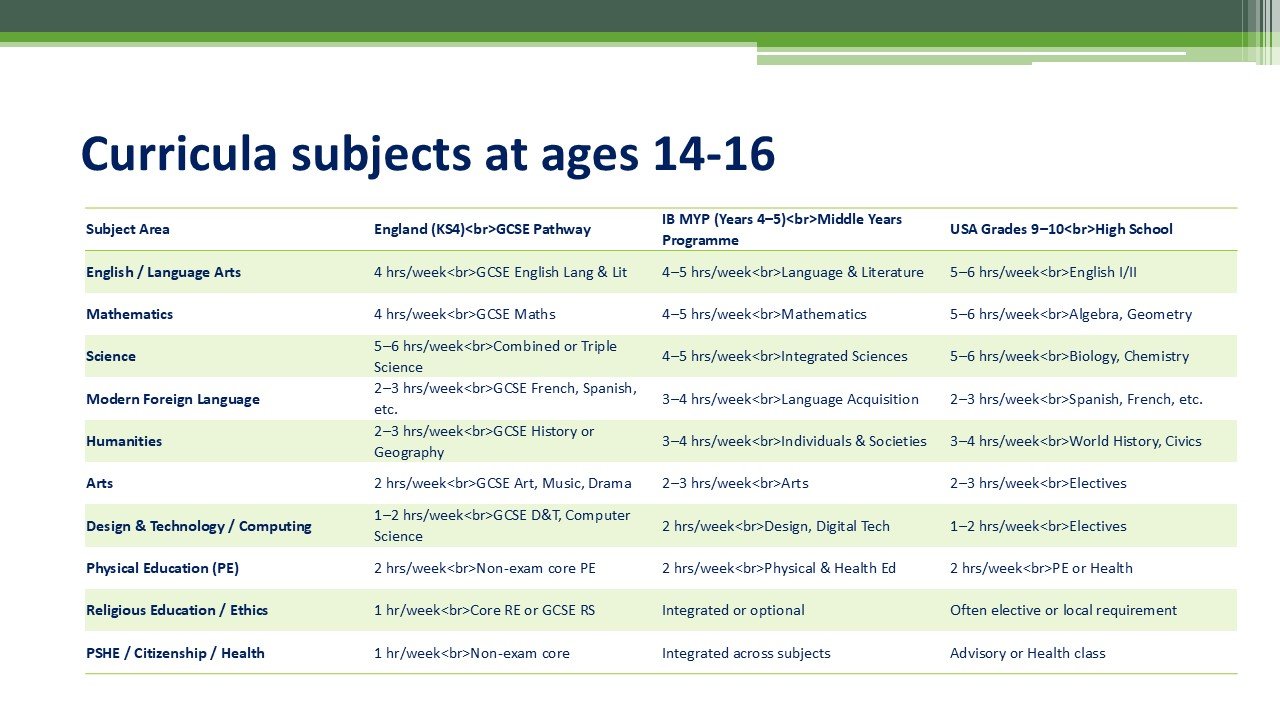
Here is a comparative table showing the prescribed subjects, weekly classroom hours, and annual instructional time for students aged 14–16 (Key Stage 4 in England), alongside the IB Middle Years Programme (Years 4–5) and U.S. High School Grades 9–10.
Annual Classroom Time Estimates ages 14-16
| System | Weekly Hours | Annual Hours (39 weeks) |
| England (KS4) | ~30 hrs/week | ~1,170 hrs/year |
| IB MYP | ~32–35 hrs/week | ~1,250–1,365 hrs/year |
| USA Grades 9–10 | ~30–32 hrs/week | ~1,170–1,250 hrs/year |
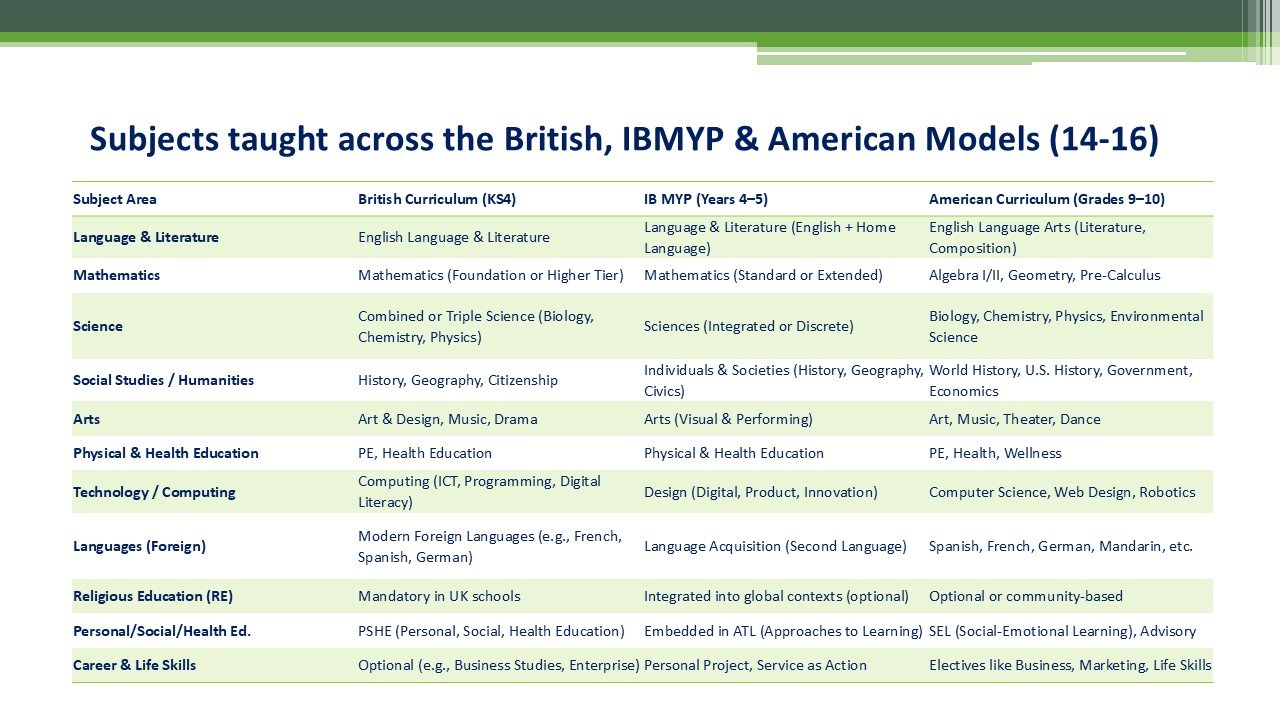
Subjects commonly taught across the three 14-16 models:
Ages 14–16 mark a critical phase in education where students begin preparing for formal qualifications and future academic or career paths. Here’s a comprehensive comparison of subjects taught across the British Curriculum (Key Stage 4), the IB Middle Years Programme (MYP Years 4–5), and the American Curriculum (Grades 9–10).
Key Philosophical Differences
- 🇬🇧 British Curriculum: Students typically prepare for GCSEs or IGCSEs, choosing core and elective subjects. Emphasis is on academic rigor and subject specialization.
- IB MYP: Students continue a broad, inquiry-based curriculum with interdisciplinary projects and a Personal Project in Year 5. Assessment is criterion-based.
- 🇺🇸 American Curriculum: Students earn credits toward graduation, with flexibility in electives and advanced courses like AP (Advanced Placement). Assessment includes GPA and standardized tests (e.g., SAT, ACT).
GCSE & IGCSE
The difference between UK GCSEs and International GCSEs:
Here is a detailed comparison between UK GCSEs and International GCSEs. Outside the UK, IGCSEs are the more accessible option. Exams can be taken at various approved examination centres worldwide.
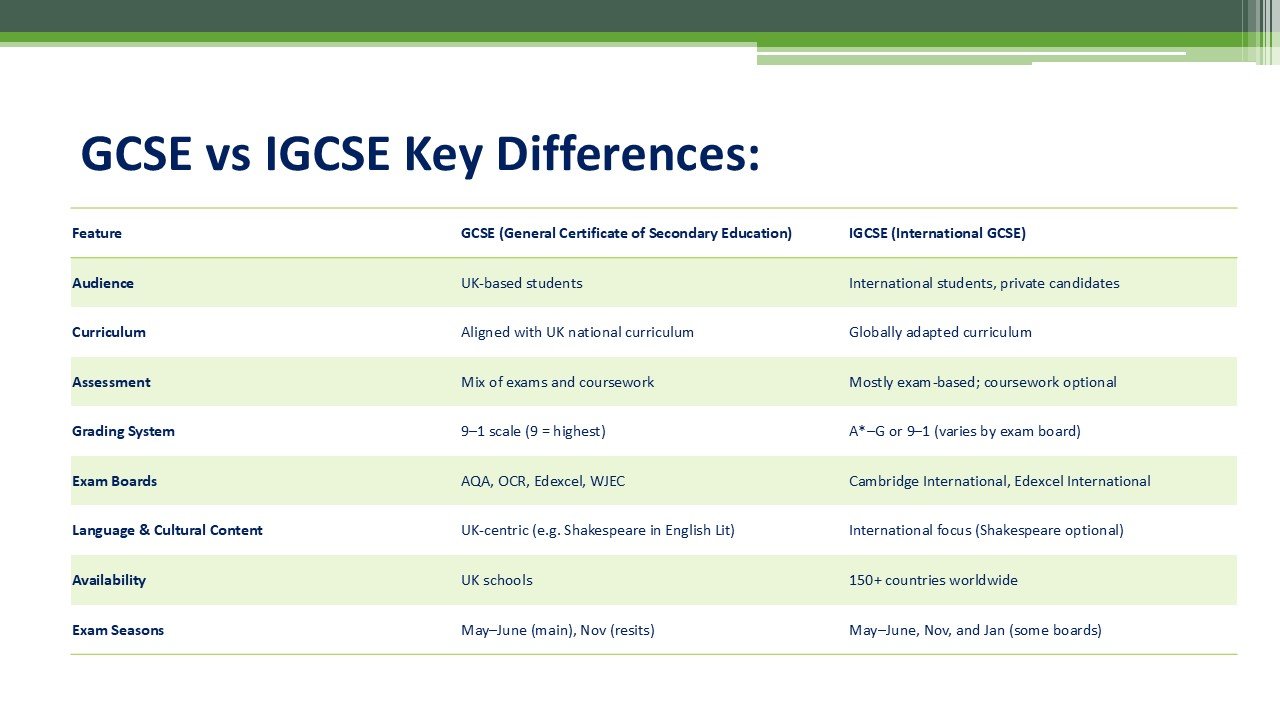
UK GCSEs are available in 60+ subjects and IGCSEs are available in 110+ subjects.
Services for the 11-16 age group
Ad-hoc & General Support, Preparatory Support and Home-education Support

Ad-hoc & General Support
11-14 & 14-16 stages
BRITISH / IB / AMERICAN MODELS
(1) Overview
Our General Education programme supports students through 11-14 and 14-16 stages, offering structured academic guidance across core and elective subjects. Whether following the British curriculum, IB MYP, or American standards, we ensure students build strong foundations and confidence in their learning.
(2) Subjects
For a list of 11-14 and 14-16 stage subjects offered by Beecham Tutors, see above.
3) Key Features
- Curriculum-aligned tutoring for British, IB MYP, and American systems
- Support for coursework, projects, and exam preparation
- Regular progress tracking and feedback
- Flexible scheduling for after-school or weekend sessions
- Optional enrichment modules (e.g., creative writing, coding, public speaking)
(4) Ideal For
Students aged 11–16 seeking academic support across subjects, consolidation of school learning, or guidance through international curricula.

Preparatory Support
14-16 age stage
BRITISH / IB / AMERICAN MODELS
(1) Overview
Our Preparatory Education coverage is designed for learners aiming to enter selective sixth forms or competitive post-16 programmes. We focus on academic excellence, entrance exam readiness and subject mastery to meet the rigorous standards of top-tier institutions.
(2) Subjects
For a list of 14-16 subjects offered by Beecham Tutors, see above.
(3) Key Features
- Diagnostic assessments to identify strengths and gaps early
- Enhanced 14-16 coverage to go beyond the 14-16 content of the British, IB and American models
- Targeted preparation for entrance exams and interviews of selective 6th-Form and similar schools and colleges
- Subject-specific deep dives and accelerated learning pathways
- Mock assessments and timed practice papers
- Guidance on school selection and application strategy
- One-on-one mentoring from experienced tutors
- Interview coaching
(4) Ideal For
Students aged 14–16 preparing for entry into selective sixth forms, scholarship programmes, or academically competitive schools.

In-residence Home Education Support
11-16 age stage
BRITISH MODEL ONLY
(1) Overview
Our Home Education services for ages 11–16 offers a fully bespoke academic experience delivered by a live-in tutor residing with the family—whether settled or itinerant. This immersive model ensures continuity, flexibility and deep personalisation, ideal for families seeking a premium educational solution outside conventional schooling. Unlike our general-education services, where tutors live out or operate online, this arrangement allows for seamless integration of learning into daily life, especially for families with demanding travel schedules or unique lifestyle needs.
(2) Subjects
For a list of 11-16 stage subjects offered by Beecham Tutors, see above.
(3) Key Features
- Live-in tutor providing continuous academic and pastoral support
- Enhanced curriculum incorporating UK, IB MYP, or US models
- Flexible timetables and learning formats (in-person, hybrid, travel-adapted)
- Regular assessments, portfolio development and exam readiness (GCSE/IGCSE)
- Enrichment modules and project-based learning
- Tutor remuneration includes salary, accommodation, travel and work-related expenses
(4) Ideal For Families with children aged 11–16 seeking a high-touch, flexible education model—particularly HNW households, frequent travellers, or those requiring discretion and continuity in academic delivery.
SUBJECTS
14-16 support offered by Beecham Tutors:
14-16 stage subject areas of support which can be aligned to all three educational models:
GROUP I (Native Language) – English Language
GROUP II (Classical Languages) – Latin – Ancient Greek
GROUP III (Mathematics) – Mathematics [Foundation or Higher-tier] – Mathematics [Core/Extended] (IGCSE only) – Statistics – Additional Maths (IGCSE only) – International Maths (IGCSE only)
GROUP IV (Sciences) – Biology – Physics – Chemistry – Comboned Science – Coordinated Science (IGCSE only) – Physical Science (IGCSE only) – Marine Science (IGCSE only)
GROUP V (Computing) – Computer Science – ICT – Algebra I (US) – Pre-Calculus (US) – Geometry (US) – Web design (US) – Robotics (US)
GROUP VI (Humanities) – History – English Literature – Global Perspectives (IGCSE only) – World History (US) US History (US)
GROUP VII (Social Sciences) – Geography – Psychology – Sociology – Economics – Business Studies – Accounting (IGCSE only) – Enterprise (IGCSE only)- Environmental Management (IGCSE only) – Environmental Science (US) – Government (US)
GROUP VIII (Foreign Languages) – English as a Foreign Language (EFL) – French – German – Spanish – Chinese – Arabic – Urdu – Portuguese (IGCSE only)
GROUP IX (Interdisciplinary) – Such matters are incorporated in subject-based teaching. For example, Science + Humanities can explore Climate change and Maths + Design can study Architecture.
GROUP X (Arts) – Music
GROUP XI (Specific Musical Instruments)
** Beecham Tutors does not support the subjects of Art & Design, Drama & Theatre, Dance, Film Studies, Media Studies, Citizenship, Religious Studies, Physical Education and Personal/Health Education.
Tailored Tuition Pathways
Key Stages 11-16

Ad-hoc Clarification & Reinforcement: For learners who need targeted support in specific topics—whether to revisit concepts taught at school or deepen understanding gained at home—we offer focused, topic-specific tuition designed to build clarity and confidence.
Subject-Based Supplementation or Replacement: Some learners benefit from studying individual subjects or clusters outside the classroom. Our subject-specific and interdisciplinary programmes can either complement school-based learning or serve as a full alternative, depending on the learner’s goals and circumstances.
Full Curriculum Tuition for Home Education: For families choosing to home-educate, we provide comprehensive curriculum-wide tuition across all key stages (5-11, 11-16 & Post-16). Whether for philosophical, logistical, or academic reasons, our programmes offer structure, expertise, and continuity tailored to each learner’s journey.
11-13 Education FAQs

If our child aged 11 is already in a non-selective UK comprehensive school, is it too late to gain entry into a selective school?
Not too late at all—there are still several pathways open for an 11-year-old in a non-selective UK comprehensive school to transition into a selective school, though timing and preparation are key.
Entry into Selective Schools at Age 11+
Most selective schools in the UK admit students at Year 7 (age 11) via the 11+ exam, which typically includes:
- English
- Maths
- Verbal Reasoning
- Non-Verbal Reasoning
If your child is already in Year 7, entry into a selective school would require:
- Mid-year transfer to a particular school (rare, but possible if places open up)
- Entry at Year 9 (age 13) – many independent schools offer a second intake here, often via the 13+ Common Entrance or their own assessments
- Entry at Year 12 (age 16) – for sixth form, based on GCSE results or entrance exams
So while the main entry point at age 11 has passed, Year 9 (age 13) and Year 12 (age 16) remain viable options for selective school entry.
Gender Restrictions
Some selective schools are single-sex, others not:
- Boys-only: e.g., Eton College, Westminster School (until sixth form)
- Girls-only: e.g., Cheltenham Ladies’ College, North London Collegiate School
- Co-educational: Many grammar and independent schools are mixed, especially at sixth form
14-16 Education FAQs

How many GCSEs or IGCSEs do the most able learners take at the age of 16 and is there a minimum or maximum desirable number?
For families navigating selective sixth form or university pathways, here is a full breakdown of how many GCSEs or IGCSEs high-achieving students typically take, what the minimum and maximum thresholds look like and how to craft an optimal subject mix.
How Many GCSEs/IGCSEs Do Top Students Take?
- Average: Most students in England take 7 to 10 GCSEs at age 16.
- High Achievers: The most able learners often take 9 to 11, with a small number taking 12 or more.
- IGCSEs: International schools offering IGCSEs typically expect students to take 9 to 12 subjects, including core and electives.
Beecham Tutors would advise that taking fewer than 8 may limit sixth form and university options unless justified by extenuating circumstances.
What is an optimal GCSE/IGCSE subject mix for more able learners?
Optimal Subject Mix for High-Achieving Students
A strong mix balances core academic rigor, breadth, and personal interest. Here is a recommended structure by Beecham Tutors:
Compulsory Core
- English Language & Literature
- Mathematics
- Science (either Combined Science or Triple: Biology, Chemistry, Physics)
Humanities
- History or Geography (or both)
Modern Foreign Language
- French, Spanish, German, Mandarin, or Latin
Creative or Technical
- Art, Music, Drama, Design & Technology, or Computer Science
Optional Academic Enrichment
- Business Studies, Economics, Religious Studies, Psychology, Sociology
For STEM-focused students
- Triple Science
- Computer Science
- Statistics or Further Maths (if offered)
For Humanities-focused students
- History, Geography, RS
- Two languages (e.g., French + Latin)
- English Literature emphasis
My daughter's school is reluctant to allow her to take more than 10 GCSE subjects, arguing that it could lead to burnout. Can Beecham Tutors help?
Yes, we can assist parents assess whether their child is capable of handling the workload involved in studying for more than 10 GCSE/IGCSE subjects.
Provided that the learner is assessed to be psychologically able and that there exist appropriate conditions at the learner’s home to take on more than 10 subjects, we can provide tuition for any number of subjects up to a maximum of 14.
There is no restriction as to the number of extra GCSEs/IGCSEs that a learner may take, over and above those which the learner’s school will permit.