5-11 Education
The primary curriculum should:
- be academically broad and challenging
- promote spiritual, moral, cultural, mental and physical development
- prepare children for the opportunities, responsibilities and experiences of subsequent years
- promote health, safety, enjoyment and achievement
Beecham tutors can help ensure none of the desired goals of 5-11 education are compromised.
Beecham Tutors can provide off-the-peg or bespoke 5-11 education:
- On a subject basis
- On a subject-cluster basis
- On a curriculum-wide basis
Our 5-11 tutors are able to teach a number of subjects across the whole 5-11 stage.
Beecham Tutors does not support certain subject areas such as religious, physical, personal, social, health or citizenship education. However, we can supply or introduce parents to specialist teachers with regard to the development of artistic, creative and musical abilities.
The subjects we teach are designed an delivered with enhanced or accelerated learning in mind, aimed to produce highly-able and confident learners at the 5-11 stage. The content of our age-specific subjects are more challenging than those taught at schools.
5-7 SUBJECTS
Educational models and their subjects at ages 5-7
Here is a comparative table showing how the UK Key Stage 1 (KS1), IB Primary Years Programme (PYP) and US Elementary Grades K–2 align in terms of subjects taught, weekly instructional hours and annual classroom time:
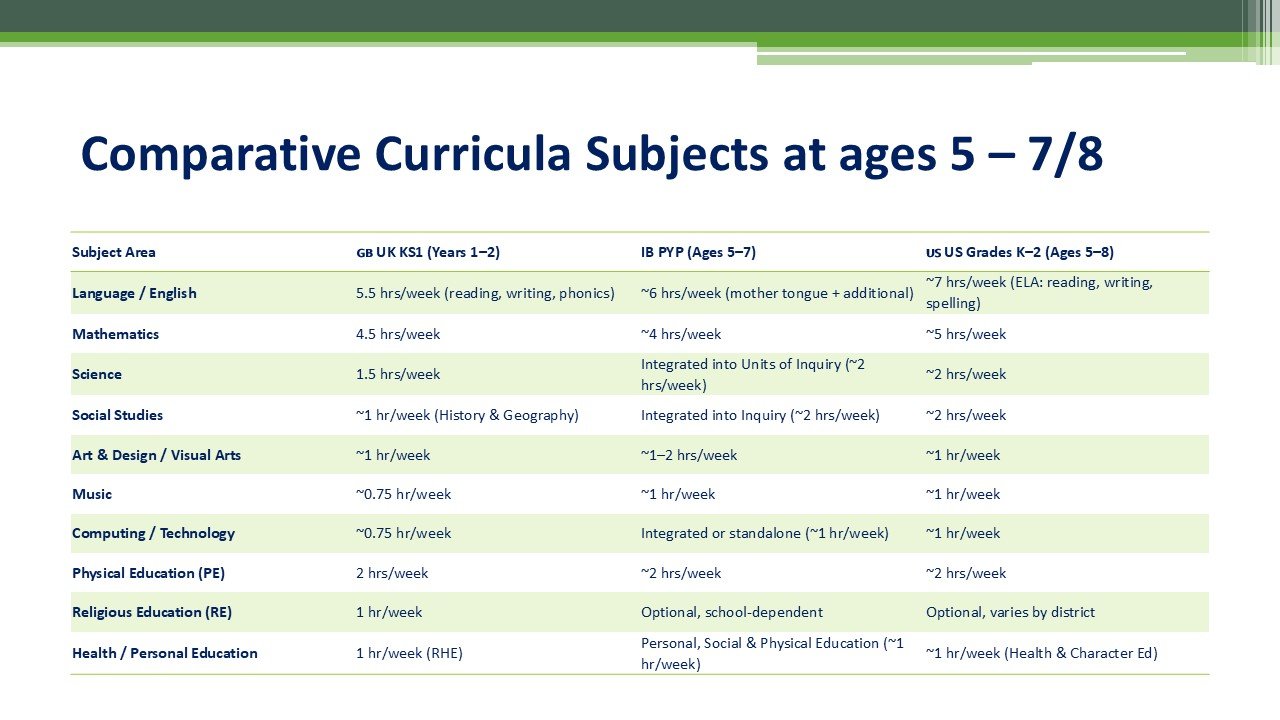
Here is comparison of weekly and annual instructional hours for children aged 5–7 across the British, International Baccalaureate (IB), and American education models:
Instruction Time Comparison: Ages 5–7
| Curriculum Model | Weekly Instruction Hours | Annual Instruction Hours | |
| British (Key Stage 1) | ~21–23 hours/week | ~800–900 hours/year | |
| IB (Primary Years Programme – PYP) | ~22–25 hours/week | ~850–950 hours/year | |
| American (Grades K–2) | ~25–28 hours/week * | ~950–1,100 hours/year * |
Key Insights
- The American model tends to offer the most instructional time, often due to longer school days (including lunch and recess times) and broader enrichment programs *.
- The IB PYP emphasizes conceptual and interdisciplinary learning, with flexible time blocks for inquiry and exploration.
- The British model is more subject-specific and exam-oriented, even at early stages, with a focus on foundational literacy and numeracy.
7-11 SUBJECTS
Educational models and their subjects at ages 7 – 11
Here is a comparative table of the UK Key Stage 2 (KS2), International Baccalaureate (IB Primary Years Programme) and USA elementary education system, focusing on subjects taught, weekly classroom hours and annual instructional time:
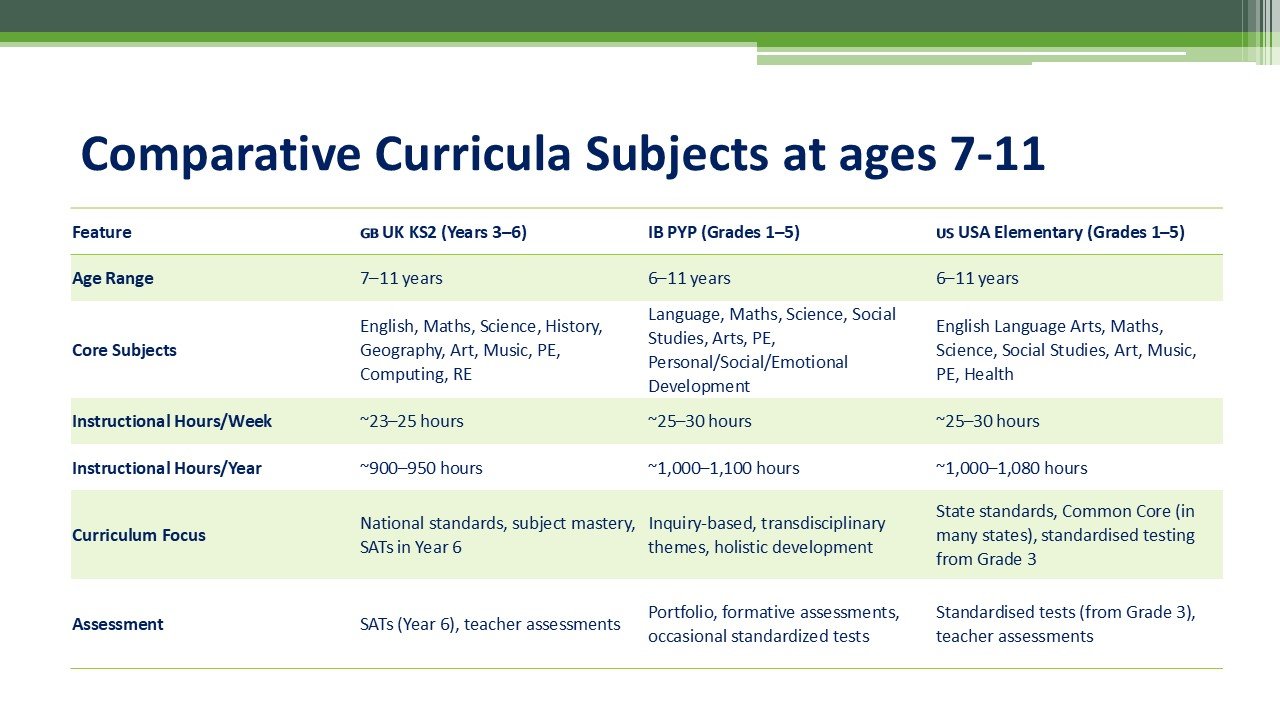
Here is a comparison of weekly and annual instructional hours for students aged 7–11 across the British, International Baccalaureate (IB), and American education models:
| Model | Weekly Instruction Hours | Annual Instruction Hours |
| British (Key Stage 2) | ~23–25 hours/week | ~950–1,000 hours/year |
| IB (Primary Years Programme) | ~24–26 hours/week | ~950–1,050 hours/year |
| American (Grades 3–5) | ~27–30 * hours/week | ~1,080–1,200 * hours/year |
* May include lunch, recess and enrichment time
Key Insights
- The American model typically has the highest instructional time, partly due to longer school days and more enrichment periods.
- The IB PYP emphasises interdisciplinary and concept-based learning, often with slightly more flexible scheduling.
- The British model is more structured around discrete subjects, with consistent weekly hours across most schools.
Our services for the 5-11 age group
Ad-hoc & General Support, Preparatory Support and Home-education Support

Ad-hoc & General Support
5-7 & 7-11 stages
BRITISH / IB /US MODELS
Overview:
Our tutorial services for learners aged 5–11 provide focused, curriculum-aligned support across individual subjects or clusters of related disciplines. Whether delivered online or in-person, each tutorial is tailored to the learner’s pace, interests and academic goals—ideal for learners attending schools or being home educated.
Subject Coverage
- Group I (Native Language) – English
- Group II (Classical Languages) – Latin – Classical Greek
- Group III (Mathematics) – Mathematics
- Group IV (Science) – Science
- Group V (Digital Literacy) – Computing & Coding Fundamentals
- Group VI (Humanities) – History
- Group VII (Social Science/Hybrid) – Geography
- Group VIII (Foreign Languages) – English as a Foreign Language (EFL) – French – Spanish – Portuguese – Italian – German – Chinese – Arabic
- Group IX (Interdisciplinary) – Included through subject teachings
- Group X (Creative Arts) – Art – Music
Optional Add-ons
- Group XI (Specific Musical Instruments)
Key Features
- Modular Structure: Choose single subjects or themed clusters for deeper engagement
- Curriculum Alignment: British, American or IB Curriculum
- Flexible Delivery: Online or in-person
- Personalised Learning Plans: Diagnostic assessments and progress tracking
- Parental Collaboration: Beecham Tutors works closely with parents to align with family goals
Ideal For
-
- Learners needing topic-specific or ad-hoc clarification, subject-specific catch up, or curriculum-wide accelerated learning.

Preparatory Support
7-10 age stage
BRITISH / IB /US MODELS
- Targeted instruction in verbal reasoning, non-verbal reasoning, mathematics and English, to help learners unlock their academic potential and thrive under exam conditions.
- Our Selective School Preparation Programme equips learners aged 7–11 with the skills, strategies, and confidence needed to excel in competitive entrance exams such as the 11+.
The 11+ exam varies slightly by region and school, but typically includes:
Core Subjects
- English: Comprehension, grammar, vocabulary and creative writing
- Mathematics: Arithmetic, problem-solving and reasoning
- Verbal Reasoning: Logic puzzles, word patterns and language-based problem solving
- Non-Verbal Reasoning: Pattern recognition, spatial awareness and visual logic
Optional Add-ons
- Interview coaching (for independent schools)
- Scholarship preparation
- Creative writing workshops
Key Components of Tuition
- Diagnostic Assessment: Identifies strengths and gaps early
- Curriculum Acceleration: Covers content beyond the standard 7-11 stage
- Exam Technique Training: Time management, multiple-choice strategies and stress reduction
- Mock Exams: Simulate real test conditions to build confidence
- Feedback & Progress Tracking: Regular reports and adaptive learning plans
Ideal For
-
- Learners needing preparation for entry into selective secondary schools at the age of 11.

In-residence Home Education Support
5-11 age stage
BRITISH MODEL ONLY
We provide in-residence home-schooling support – as suited to the needs of the families who have opted out of school-based education. Typically this is for:
- Itinerant families who have opted out of school-based education for their children – because they reside or work in multiple countries during the academic year.
- Non-itinerant families who have opted out of school-based education for their children – and who reside in a fixed location during the academic year. Such families may have opted out of school-based education for other reasons such as:
Concerns About School Environment
- Bullying or peer pressure
- Safeguarding issues
- Mental health challenges exacerbated by school stress
Educational Philosophy
- Desire for a more tailored or rigorous education
Individual Needs
- Health issues that make regular attendance difficult
Family Values & Lifestyle
- Religious or cultural reasons
Obs:
- For home-educating families, we recommend following an exam-only curriculum such as in the British model.
- We advise on which countries permit or prohibit home education and suggest solutions to potential obstacles.
Ideal For
-
- Families, whether settled or itinerant, needing tutors in residence.
Tailored Tuition Pathways
Key ages 5-11

Ad-hoc Clarification & Reinforcement: For learners who need targeted support in specific topics—whether to revisit concepts taught at school or deepen understanding gained at home—we offer focused, topic-specific tuition designed to build clarity and confidence.
Subject-Based Supplementation or Replacement: Some learners benefit from studying individual subjects or clusters outside the classroom. Our subject-specific and interdisciplinary programmes can either complement school-based learning or serve as a full alternative, depending on the learner’s goals and circumstances.
Full Curriculum Tuition for Home Education: For families choosing to home-educate, we provide comprehensive curriculum-wide tuition across all key stages (5-11, 11-16 & Post-16). Whether for philosophical, logistical, or academic reasons, our programmes offer structure, expertise, and continuity tailored to each learner’s journey.
Key Stage 1 & 2 FAQs (ages 5-11)
What is a phonics check and in which year is it prescribed in national curricula?
A phonics check is a short assessment used to evaluate how well children can decode words using phonics—a method of teaching reading by correlating sounds with letters or groups of letters. It typically involves reading a mix of real and pseudo-words (nonsense words) aloud to test their ability to apply phonics rules.
When Is It Prescribed?
In the UK national curriculum, the phonics screening check is:
- Prescribed in Year 1 (typically for children aged 5–6)
- If a child does not meet the expected standard, they re-take it in Year 2
This check is a statutory requirement for all schools following the national curriculum, including academies and free schools.
Obs: For home-educated learners, Beecham Tutors advises parents on how and when a phonics check may be conducted.
What is a Times Table Check and in which year is it prescribed in national curricula?
The Times Table Check, officially known as the Multiplication Tables Check (MTC), is a statutory assessment in the UK national curriculum designed to determine whether pupils can recall their multiplication tables fluently.
What Is It?
- A short online test with 25 questions
- Covers multiplication tables from 2 to 12
- Pupils have 6 seconds to answer each question, with a 3-second pause between questions
- Focuses more heavily on the 6, 7, 8, 9, and 12 times tables
When Is It Prescribed?
- Prescribed in Year 4 (typically for children aged 8–9)
- Administered in June of the academic year
- Statutory for all state-funded schools in England
Its purpose is to help schools identify pupils who need additional support with their times tables, which are foundational for success in later mathematics.
Obs: Beecham Tutors places emphasis on the earlier development of Times-Table ability.
What are SATs in the British national curriculum and when are they administered?
In the British national curriculum, SATs stands for Standard Assessment Tests (or Standard Attainment Tests). These are statutory assessments used to measure pupils’ progress and attainment in core subjects like English and mathematics.
What Are SATs?
SATs assess:
- Reading
- Grammar, punctuation, and spelling
- Mathematics
- Writing (teacher-assessed)
- Science (teacher-assessed at Key Stage 1; tested in a sample of schools at Key Stage 2)
They combine formal testing with teacher assessments to give a rounded view of a pupil’s performance.
When Are SATs Administered?
- KS1 SATs are typically administered in May of Year 2.
- KS2 SATs are also held in May, but in Year 6.
These assessments help track progress and inform state-funded secondary schools about incoming pupils’ attainment levels.
How do state-funded primary schools identify pupils that are high achievers and ought to try to enter selective secondary schools?
State-funded primary schools in England do not have a formal, national process for identifying pupils who should attempt entry into selective schools (such as grammar schools via the Eleven-plus). Primary-school support for selective secondary school entry varies widely:
- Some schools actively encourage high-achieving pupils to apply to grammar or independent schools.
- Others remain neutral, especially if they are comprehensive schools or in areas without selective options.
Therefore, Beecham Tutors offers assessment services to identify pupils’ progress at state-funded primary schools and suggest strategies to help parents identify paths to selective secondary schooling – even if their current areas of residence do not offer selective secondary schooling.