
Post-16 Education
Although the post-16 stage falls within some definitions of secondary (11-18/19) education, it is not a compulsory stage of education in all countries. Fewer subjects are studied at this stage, but in greater depth and the choice of programme of study is largely determined by the learner’s post-18/19 objectives.
Our post-16 services focus on those learners whose post-16 objectives are university entry.
Irrespective of whether a British, International Baccalaureate, or any other national educational programme is being followed (or desired), our tutors prepare students for entry into the most reputable universities in the world. For students in non-English-speaking countries, this also incorporates developing proficiency in English as a Foreign Language (EFL).
We provide off-the-peg or bespoke tuition:
- On a subject basis (Economics)
- On a subject cluster basis (Physics, Chemistry, Biology)
- On a mixed subject cluster basis (English Language, History, Mathematics)
Most of our post-16 tutors are able to teach a number of subjects in the same cluster. For example, an Economics tutor will be able to teach Business Studies; and a Mathematics tutor will be able to teach Statistics.
Beecham Tutors does not support certain subject areas – please see below. However, we can supply or introduce parents to specialist teachers with regard to the development of artistic, creative and musical abilities.
The subjects we teach are designed an delivered with enhanced or accelerated learning in mind, aimed to produce highly-able and confident learners at the 16-18 stage. The content of our age-specific subjects are more challenging than those taught at selective schools.
Characteristics of post-16 educational models
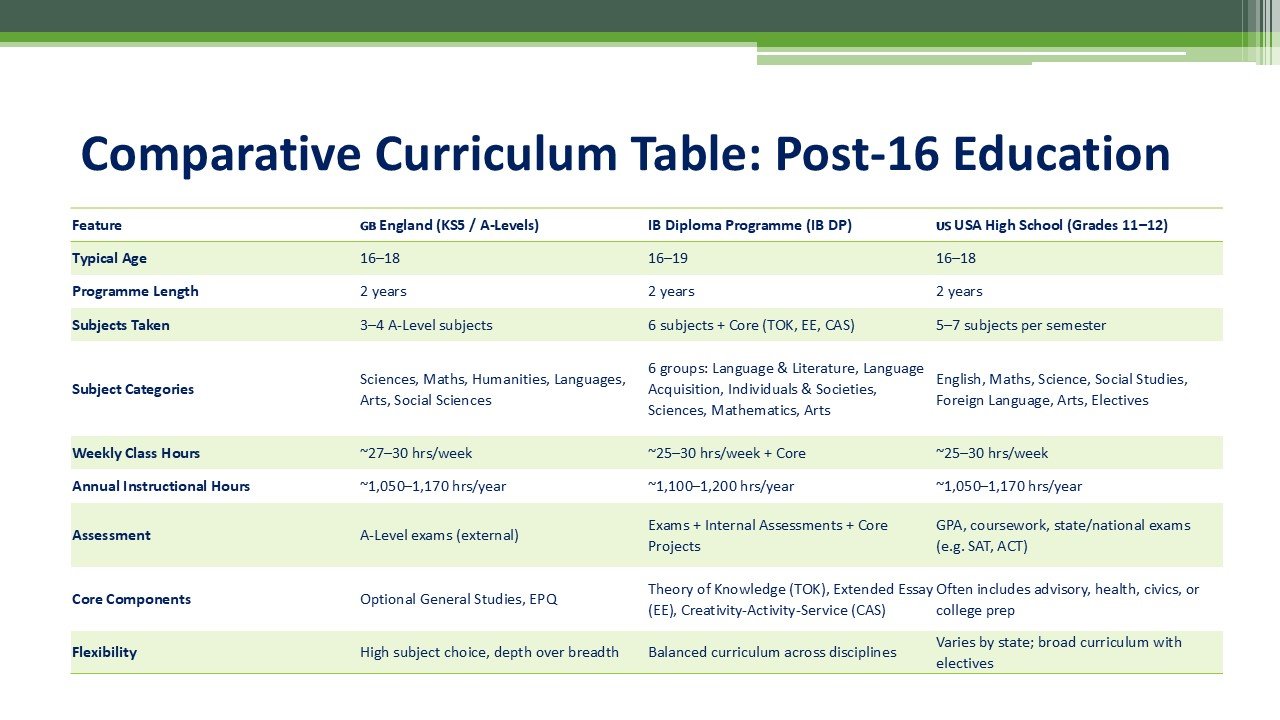
Here is a comparative table showing the characteristics of the post-16 educational models:
Subjects commonly taught across the three post-16 models
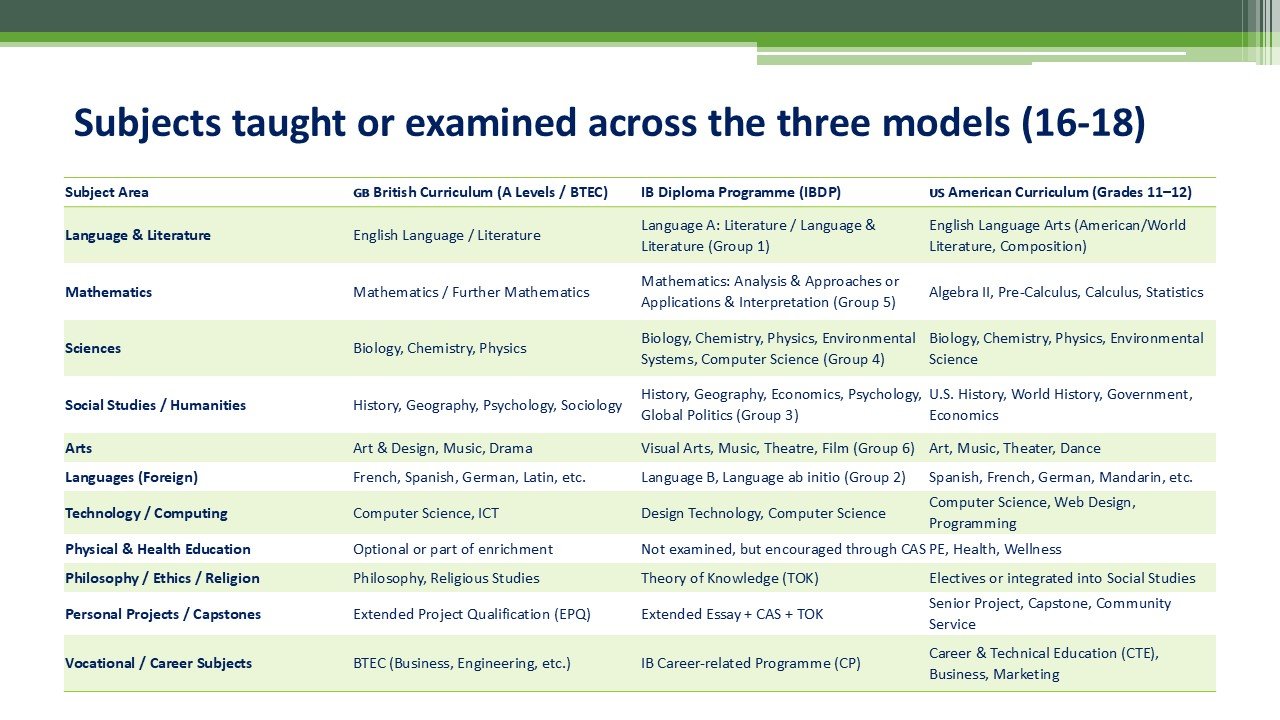
Ages 16–18 represent the final stage of secondary education, where students specialize in subjects that prepare them for university, careers, or vocational pathways. Here’s a comprehensive comparison of subjects taught or examined across the British Curriculum (A Levels), the IB Diploma Programme (IBDP), and the American High School Curriculum (Grades 11–12).
Key Philosophical Differences
- 🇬🇧 British Curriculum: Students typically choose 3–4 A Level subjects. Highly specialised and exam-focused, leading to university entrance.
- IB Diploma Programme: Students study 6 subjects across disciplines, plus core components: Theory of Knowledge, Extended Essay, and CAS (Creativity, Activity, Service). Emphasises global citizenship and critical thinking.
- 🇺🇸 American Curriculum: Students earn credits across a broad range of subjects, with flexibility to choose electives and advanced courses like AP (Advanced Placement) or Dual Enrollment. GPA and standardised tests (SAT/ACT) are key for college admissions.
Here is comparison of weekly and annual instructional hours for students aged 16–18 across the British, International Baccalaureate (IB), and American education models:
Instruction Time Comparison: Ages 16–18
|
Curriculum Model |
Weekly Instruction Hours |
Annual Instruction Hours |
|
British (A Levels) |
~18–22 hours/week |
~700–850 hours/year |
|
IB Diploma Programme (IBDP) |
~25–30 hours/week |
~950–1,100 hours/year |
|
American High School (Grades 11–12) |
~25–32 hours/week |
~1,000–1,200 hours/year |
Key Insights
- The IB Diploma Programme has the most structured and demanding schedule, with interdisciplinary components and extended projects.
- The British A Level system allows for deep specialisation, often with fewer subjects and slightly fewer hours.
- The American model offers the broadest curriculum and highest instructional time, especially when students take Advanced Placement (AP) or Dual Enrollment courses.
POST-16
The difference between UK A Levels and International A Levels
Here is a detailed comparison between UK A Levels and International A Levels (IALs), followed by a comprehensive list of subjects offered under both pathways.
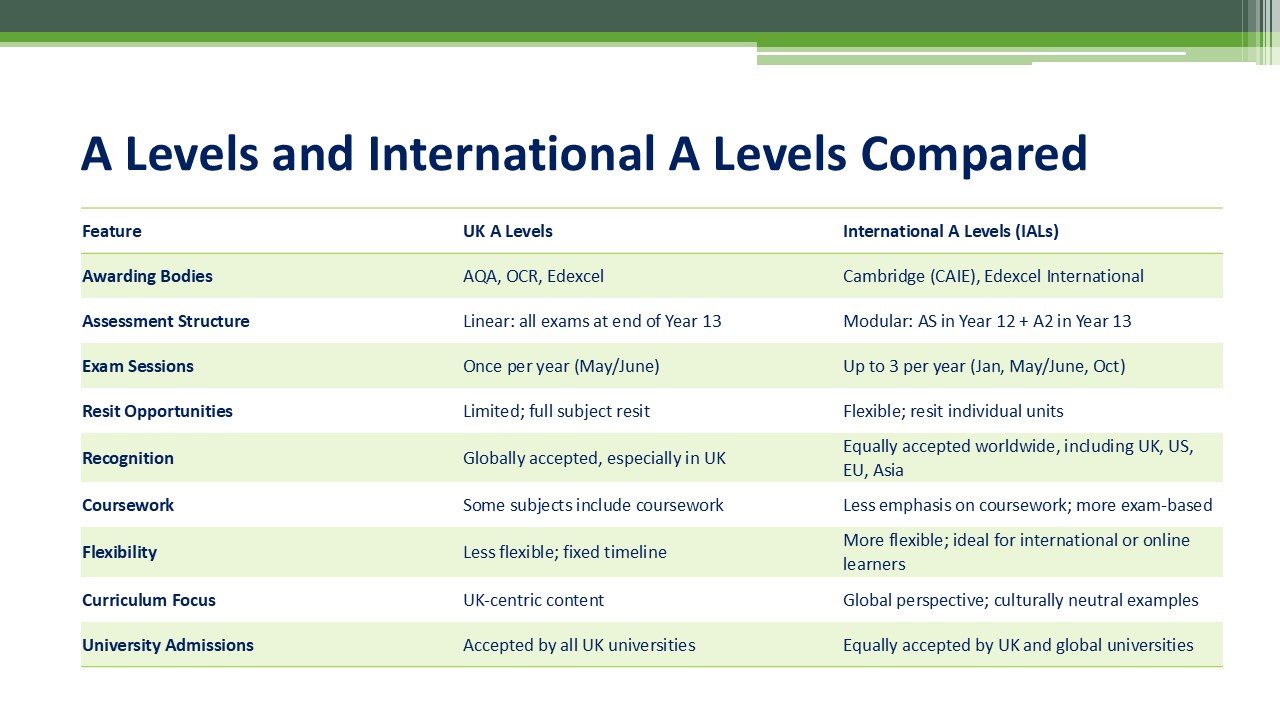
Cambridge International AS & A Levels are available in 55 subjects, while UK A Levels offer around 85 subjects, depending on the exam board and school
SUBJECTS
Post-16 support offered by Beecham Tutors:
Post-16 stage subject areas of support which can be aligned to all three educational models:
GROUP I (Native Language) – English Language
GROUP II (Classical Languages) – Latin – Classical Greek
GROUP III (Mathematics) – Mathematics – Further Mathematics – Statistics – Maths AA or AI (IB) – Algebra II (US only) – Pre-calculus (US only) – Calculus (US only)
GROUP IV (Sciences) – Biology – Physics – Chemistry – Marine Science (IAL only) – Environmental Management (IAL only)
GROUP V (Computing) – Computer Science – Information Technology (IAL only)
GROUP VI (Humanities) – History – English Literature – Philosophy – Classical Civilisation – Classical Studies (IAL only) – Islamic Studies (IAL only)
GROUP VII (Social Sciences) – Geography – Psychology – Sociology – Economics – Business Studies – Law – Accounting – Politics – Government & Politics – Anthropology
GROUP VIII (Foreign Languages) – English as a Foreign Language (EFL) – French – German – Spanish – Chinese – Japanese – Arabic – Urdu – Portuguese (IAL only) – Tamil (IAL only)
GROUP IX (Interdisciplinary) – Thinking Skills (IAL only) – Global Perspectives & Research (IAL) – Environmental Science – General Studies – Theory of Knowledge (IB) – Extended Essay (IB) – Environmental Systems & Societies (IB) – World Studies extended Essay
GROUP X (Arts) – Music – Digital Media & Design (IAL only)
GROUP XI (Specific Musical Instruments)
** Beecham Tutors does not support the subjects of Art & Design, Drama & Theatre, Dance, Film Studies, Media Studies, Religious Studies, Physical Education and Personal/Health Education.
Services for the 16-18 age group
Ad-hoc & General Support, Preparatory Support and Home-education Support

Ad-hoc & General Support
16-18 stage
BRITISH / IB / AMERICAN MODELS
(1) Overview
Our General Education services supports students through A Levels, IB Diploma and American High School curricula. We provide expert tutoring across academic disciplines, helping students master subject content, refine exam technique and prepare for university-level study.
(2) Subjects
We have developed enhanced subject-specific syllabi which go beyond the 16-18 content of the three educational models.
For a list of 16-18 subjects offered by Beecham Tutors, see above.
(3) Key Features
- Curriculum-aligned support for A Level, IB Diploma, and AP courses
- University preparation: personal statements, interview coaching, admissions tests
- Regular progress reviews and academic mentoring
- Flexible scheduling and tailored study plans
- Support for coursework, internal assessments, and extended essays
(4) Ideal For
Students aged 16–18 seeking academic excellence in post-16 qualifications, whether aiming for top universities or broad subject mastery.

Preparatory Support
16-18 stage
BRITISH / IB / AMERICAN MODELS
(1) Overview
Our Preparatory Education services are designed for students targeting competitive university admissions, scholarships, or specialist pathways such as medicine, law, or engineering. We offer intensive preparation for entrance exams, interviews and subject-specific challenges.
(2) Subjects
We have developed enhanced subject-specific syllabi which go beyond the 16-18 content of the three educational models.
For a list of 16-18 subjects offered by Beecham Tutors, see above.
Additionally, the preparatoty programme includes:
- University Admissions Tests (e.g., UCAT, LNAT, TSA, BMAT)
- Interview Preparation and Personal Statement Coaching
(3) Key Features
- Diagnostic Assessment to identify strengths and gaps early
- Enhanced subject syllabi which covers the 16-18 content beyond that expected in the three educational models
- Specialist tutoring for Oxbridge, Russell Group, and Ivy League pathways
- Mock interviews and timed entrance exam practice
- Strategic guidance on course and university selection
- Mentoring from subject experts and alumni
- Portfolio and application support for arts and vocational programmes
(4) Ideal For
Students aged 16–18 preparing for competitive university entry, scholarship applications, or specialist academic routes requiring advanced preparation.

In-residence Home Education Support
16-18 stage
BRITISH MODEL ONLY
(1) Overview
Our Post-16 Home Education services is designed for students pursuing A Levels or International A levels outside traditional institutions. Delivered by a live-in tutor placed within the family unit, this model offers unparalleled academic continuity and lifestyle adaptability. It is especially suited to families navigating international relocations, intensive travel schedules, or requiring a discreet and elite educational solution. The tutor’s presence ensures consistent mentoring, academic rigour and holistic support throughout the learner’s pre-university journey.
(2) Subjects
We have developed enhanced subject-specific syllabi which go beyond the 16-18 content of the three educational models.
For a list of 16-18 subjects offered by Beecham Tutors, see above.
(3) Key Features
- Live-in tutor offering full-time academic and pastoral guidance
- Customized curriculum planning and exam registration support
- Flexible timetables and blended learning formats
- Diagnostic Assessment to identify strengths and gaps early
- Progress tracking, academic reporting, and university preparation
- Integration of career guidance and enrichment activities
- Tutor remuneration includes salary, accommodation, travel and incidental expenses
(4) Ideal For Students aged 16–18 in HNW families or globally mobile households seeking a tailored, immersive education experience—whether for homeschooling, accelerated learning, or elite university preparation.
Tailored Tuition Pathways
Key ages 16-18

Ad-hoc Clarification & Reinforcement: For learners who need targeted support in specific topics—whether to revisit concepts taught at school or deepen understanding gained at home—we offer focused, topic-specific tuition designed to build clarity and confidence.
Subject-Based Supplementation or Replacement: Some learners benefit from studying individual subjects or clusters outside the classroom. Our subject-specific and interdisciplinary programmes can either complement school-based learning or serve as a full alternative, depending on the learner’s goals and circumstances.
Full Curriculum Tuition for Home Education: For families choosing to home-educate, we provide comprehensive curriculum-wide tuition across all key stages (5-11, 11-16 & Post-16). Whether for philosophical, logistical, or academic reasons, our programmes offer structure, expertise, and continuity tailored to each learner’s journey.
Post-16 Education FAQs

In which countries is post-16 education compulsory?
Countries Where Post-16 Education Is Compulsory until the age of 18 – whether through schooling or vocational pathways: Netherlands, Belgium, Germany, Austria, Portugal, Hungary, England & South Korea.
Most other countries—including the United States, Canada, Australia, India, and Japan—do not legally require education beyond age 16. However, cultural norms and university aspirations often lead students to continue voluntarily.
Summary:
- Europe leads in extending compulsory education to age 18, often including vocational options.
- Anglophone countries tend to stop at 16, though participation rates remain high post-16.
- Policy trends show increasing emphasis on keeping students engaged through flexible pathways like apprenticeships, online learning and dual enrolments.
What is the Pre-U qualification?
The Cambridge Pre-U is a post-16 qualification developed by Cambridge Assessment International Education, designed to prepare students for university with a strong emphasis on independent thinking, research skills and academic depth.
Pre-U has been phased out as of 2023-4, but its rigour remains a useful reference point when comparing academic pathways. The top grade in Pre-U exceeds A* at L Level.
What is the S Level or S Paper in the context of A Levels?
The S Level, also known as the Scholarship Level or Special Paper, was a UK qualification designed to stretch the most academically able A Level students—especially those applying to elite universities like Oxford and Cambridge.
They were much harder than A Levels—questions were designed to test deep reasoning, problem-solving and the ability to handle unfamiliar situations.
The S Level was phased out in 2001, but remains a useful reference point of academic distinction at A Level.
After its retirement the S Level was succeeded by AEA (Advanced Extension Awards and STEP (Sixth Term Examination Paper), however unlike the S Levels which were available in various subjects the AEA and STEP are mathematics-related.
With respect to international schools worldwide, which system has more schools, those offering A levels or those offering IBDP?
Based on our data and insights, more international schools offer A-levels than the International Baccalaureate Diploma Programme (IBDP).
Our data shows over 10,000 schools providing A levels, compared to 3,700 schools providing the IBDP.
Why A-Levels Are More Widely Offered:
- Flexibility: Schools can choose subject combinations and exam boards (e.g. Edexcel, Cambridge).
- Specialisation: Appeals to students with focused academic interests.
- Lower infrastructure demands: Easier to implement than the full IB continuum (PYP, MYP, DP).
Is it possible to have a regional breakdown of where A-levels or IB are most dominant (e.g. Asia vs Europe vs Middle East)?
Here’s a regional breakdown of how widely A-levels and the International Baccalaureate Diploma Programme (IBDP) are offered across major international school hubs:
Regional Comparison: A-Levels vs IBDP
|
Region |
A-Levels Presence |
|
Asia-Pacific |
Strong in British international schools (e.g. Hong Kong, Singapore, Malaysia) |
|
Europe |
Dominant in UK and British schools across the continent |
|
Middle East |
A-levels are common in British schools (e.g. UAE, Qatar, Saudi Arabia) |
|
Africa |
A-levels more prevalent in former British colonies |
|
Americas |
A-levels rare, mostly in British schools |
Summary:
- A-levels dominate in regions with strong British education traditions.
- IBDP is more globally recognised and gaining traction in regions focused on international university admissions.
- Many schools in UAE, Singapore, and Hong Kong offer both programmes, giving students flexibility.
Beecham Tutors helps 16-18 learners and their parents to choose between the two systems based on their goals.
I am an executive for a multi-national corporation, I am often moved from one region of the world to another; in these circumstances, it may be undesirable to move my children from one type of system (IGCSEs/A levels) to another (IB MYP/DP). What may be the better system to start with, to avoid potential difficulty in finding schools offering the same system?
For a globally mobile family, A-levels may offer more continuity across regions. But if you’re based in major cities with strong IB infrastructure, the IB can be a powerful and enriching pathway.
| Feature | A-Level Schools (IGCSE & A-Levels) |
| Global Availability | Tens of thousands of schools globally offer IGCSE/A-levels, especially in British and Commonwealth systems |
| Curriculum Flexibility | Flexible: Students choose 3–4 subjects freely; wide range of exam boards and syllabi |
| School & Learner Autonomy | Decentralised: Multiple exam boards (Cambridge, Edexcel, OCR); exams can be taken at registered centres without attending the school |
| Assessment Style | Exam-heavy: Some subjects are exam-only; coursework optional depending on board and subject |
| Academic Rigor | Allows deep specialisation; rigorous in chosen subjects but less interdisciplinary by design |
| University Recognition | Strong recognition in UK, Commonwealth, and increasingly global institutions |
| Mobility & Continuity | Easier to transfer between schools and countries due to modular and board-based system |
Summary
- IB offers a holistic, globally standardised education with strong emphasis on critical thinking and global citizenship.
- A-levels/IGCSE provide flexibility, specialisation and easier portability across international schools.
Beecham Tutors has global reach and we can assist families in school search, admissions processes, relocation and bridging educational support for children moving from one system to another.